Soil
What soil type is my property, and how does it affect drainage?
The soil under a house decides how fast rain soaks in, how long the yard stays wet, and whether the ground swells and shrinks. The one thing to know first: is it sandy, or is it clay?
Sandy ground drains fast. Clay ground soaks up rain slowly, so more of it runs off, and some clay swells when wet. To see the soil under an address, open Terreflow’s Soil tab. For the official, more detailed U.S. soil map, look the property up in the USDA Web Soil Survey.
Sand or clay?
Soil is a mix of sand, silt and clay. Which one there is most of decides what happens when it rains:
- Sandy: large grains with gaps between them. Rain soaks in quickly and the ground dries fast.
- Loamy (in between): a balanced mix. Rain soaks in at a moderate rate; most gardens and lawns like it.
- Clay: tiny particles packed tight. Rain soaks in slowly, puddles linger, and more water runs off. Some clay swells when wet and shrinks when dry.
Two other kinds of ground matter whatever they’re made of: wet ground, where water already sits near the surface so rain has nowhere to go, and thin soil over rock, which has little room to hold rain.
The soil types on the map
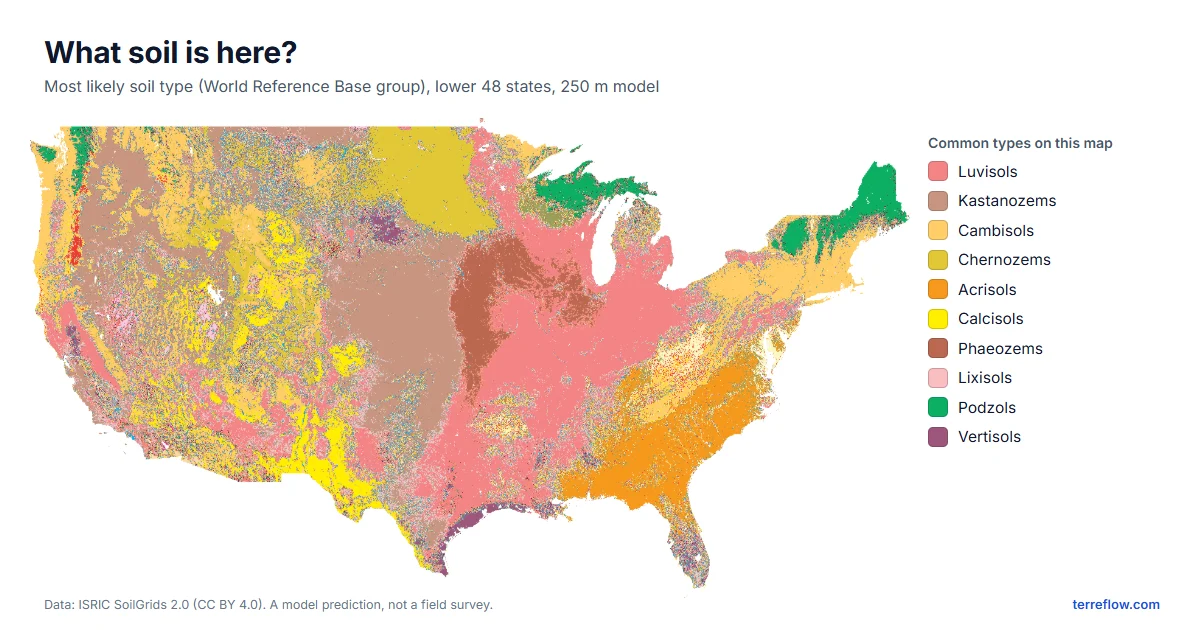
The map uses the international World Reference Base soil names. You don’t need to learn them: each one falls into one of the groups above.
| Ground | What rain does | Soil types on the map |
|---|---|---|
| Sandy | Rain soaks in quickly and little runs off. | Arenosols, Podzols |
| In between (loamy) | Rain soaks in at a moderate rate. | Cambisols, Kastanozems, Chernozems, Phaeozems, Umbrisols, Regosols, Fluvisols, Calcisols, Gypsisols, Durisols, Andosols, Nitisols, Ferralsols, Cryosols, Solonchaks |
| Clay below the surface | Rain soaks in, then slows at the clay layer. | Luvisols, Acrisols, Alisols, Lixisols, Albeluvisols, Plinthosols |
| Clay | Rain soaks in slowly, so more of it runs off. | Vertisols, Solonetz |
| Wet ground | The ground stays wet after rain. | Gleysols, Stagnosols, Planosols, Histosols |
| Thin soil over rock | There is little soil to hold rain; what happens next depends on the rock below. | Leptosols |
Groups follow the usual texture of each soil type; a given lot can differ. U.S. soil surveys use different names (USDA Soil Taxonomy), but the same sand-to-clay idea applies.
Soil and drainage
Terreflow’s Surface Drainage map shows where the shape of the land sends rainwater. Soil decides how much rain gets that far. On clay or waterlogged ground, more of a storm runs off across the surface toward the valleys and low spots the drainage map shows; on sand, more soaks in where it falls. A low spot on clay holds water longer than one on sand.
Swelling clay (Vertisols, common along the Texas and Louisiana Gulf Coast) also shrinks and cracks as it dries, which can move slabs and foundations. That’s why builders test for expansive clay.
Engineers put the same idea into four hydrologic soil groups (USDA NRCS), by how much runoff a soil produces when thoroughly wet: A, sandy, under about 10% clay, low runoff; B, about 10–20% clay; C, about 20–40% clay; and D, over about 40% clay or with a high water table or a water-blocking layer within 20 inches of the surface, high runoff. The Web Soil Survey lists the group for each soil.
Soil around the 50 largest cities
What the ground is mostly like across each city’s map area. Click a city for its flood and drainage map, where the Soil tab shows any address.
See all 50 cities
| City | Mostly |
|---|---|
| Albuquerque, NM | In between (loamy) (Calcisols, Fluvisols, Cambisols); clay below the surface (Luvisols) |
| Atlanta, GA | Clay below the surface (Acrisols) |
| Austin, TX | Clay below the surface (Luvisols) |
| Bakersfield, CA | In between (loamy) (Fluvisols, Cambisols, Regosols, Kastanozems) |
| Baltimore, MD | Clay below the surface (Luvisols, Acrisols, Alisols) |
| Boston, MA | In between (loamy) (Cambisols) |
| Charlotte, NC | Clay below the surface (Acrisols, Luvisols) |
| Chicago, IL | Clay below the surface (Luvisols) |
| Colorado Springs, CO | In between (loamy) (Kastanozems, Cambisols, Chernozems); clay below the surface (Luvisols) |
| Columbus, OH | Clay below the surface (Luvisols) |
| Dallas, TX | Clay below the surface (Luvisols) |
| Denver, CO | In between (loamy) (Kastanozems) |
| Detroit, MI | Clay below the surface (Luvisols) |
| El Paso, TX | In between (loamy) (Calcisols) |
| Fort Worth, TX | Clay below the surface (Luvisols) |
| Fresno, CA | Clay below the surface (Luvisols); in between (loamy) (Kastanozems, Cambisols, Regosols) |
| Houston, TX | Clay below the surface (Luvisols); clay (Vertisols) |
| Indianapolis, IN | Clay below the surface (Luvisols) |
| Jacksonville, FL | Clay below the surface (Acrisols, Luvisols) |
| Kansas City, MO | In between (loamy) (Phaeozems) |
| Las Vegas, NV | In between (loamy) (Calcisols, Gypsisols, Regosols); clay below the surface (Luvisols) |
| Long Beach, CA | In between (loamy) (Fluvisols, Cambisols) |
| Los Angeles, CA | In between (loamy) (Kastanozems, Cambisols, Fluvisols); clay below the surface (Luvisols) |
| Louisville, KY | Clay below the surface (Luvisols) |
| Memphis, TN | Clay below the surface (Luvisols) |
| Mesa, AZ | In between (loamy) (Calcisols, Cambisols) |
| Miami, FL | Thin soil over rock (Leptosols); wet ground (Gleysols) |
| Milwaukee, WI | Clay below the surface (Luvisols) |
| Minneapolis, MN | Clay below the surface (Luvisols) |
| Nashville, TN | Clay below the surface (Luvisols, Acrisols, Alisols) |
| New York, NY | Clay below the surface (Luvisols); in between (loamy) (Cambisols) |
| Oakland, CA | In between (loamy) (Kastanozems, Cambisols); clay below the surface (Luvisols) |
| Oklahoma City, OK | In between (loamy) (Kastanozems, Cambisols); clay below the surface (Luvisols) |
| Omaha, NE | In between (loamy) (Phaeozems) |
| Philadelphia, PA | Clay below the surface (Luvisols, Alisols, Acrisols) |
| Phoenix, AZ | In between (loamy) (Calcisols, Cambisols, Regosols); clay below the surface (Luvisols) |
| Portland, OR | Clay below the surface (Luvisols); in between (loamy) (Cambisols, Kastanozems) |
| Raleigh, NC | Clay below the surface (Acrisols, Alisols, Luvisols) |
| Sacramento, CA | Clay below the surface (Luvisols); clay (Vertisols) |
| San Antonio, TX | Clay below the surface (Luvisols); in between (loamy) (Kastanozems, Cambisols) |
| San Diego, CA | In between (loamy) (Regosols, Cambisols, Kastanozems); clay below the surface (Luvisols) |
| San Francisco, CA | In between (loamy) (Kastanozems, Cambisols) |
| San Jose, CA | In between (loamy) (Kastanozems, Cambisols) |
| Seattle, WA | In between (loamy) (Cambisols, Andosols); sandy (Podzols) |
| Tampa, FL | Clay (Vertisols); clay below the surface (Acrisols, Luvisols) |
| Tucson, AZ | In between (loamy) (Calcisols, Fluvisols, Regosols); clay below the surface (Luvisols) |
| Tulsa, OK | Clay below the surface (Luvisols); in between (loamy) (Phaeozems) |
| Virginia Beach, VA | Clay below the surface (Acrisols, Luvisols, Alisols) |
| Washington, DC | Clay below the surface (Acrisols, Luvisols, Alisols) |
| Wichita, KS | In between (loamy) (Kastanozems) |
What the map can’t tell you
- It’s a model, not a survey. SoilGrids predicts soil types worldwide at 250 m (about 800 feet) from field samples, climate, terrain and satellite data. It can be wrong for one lot, and in places it shows types that local surveys don’t.
- Construction changes soil. Fill, grading and compaction around new homes often replace the natural topsoil.
- Not for design decisions. For a foundation, septic system or drainage design, check the USDA Web Soil Survey (drainage class, hydrologic soil group, depth to water table, shrink-swell) and get a soil or percolation test from a licensed professional.
Before you buy, work through the terrain checklist.
Check an address
Soil type, surface drainage, sunlight and the FEMA flood zone, on one 3D map.
Open the map →