Houston (Harris County), TX Flood Zone & Drainage Map

Address
Overview

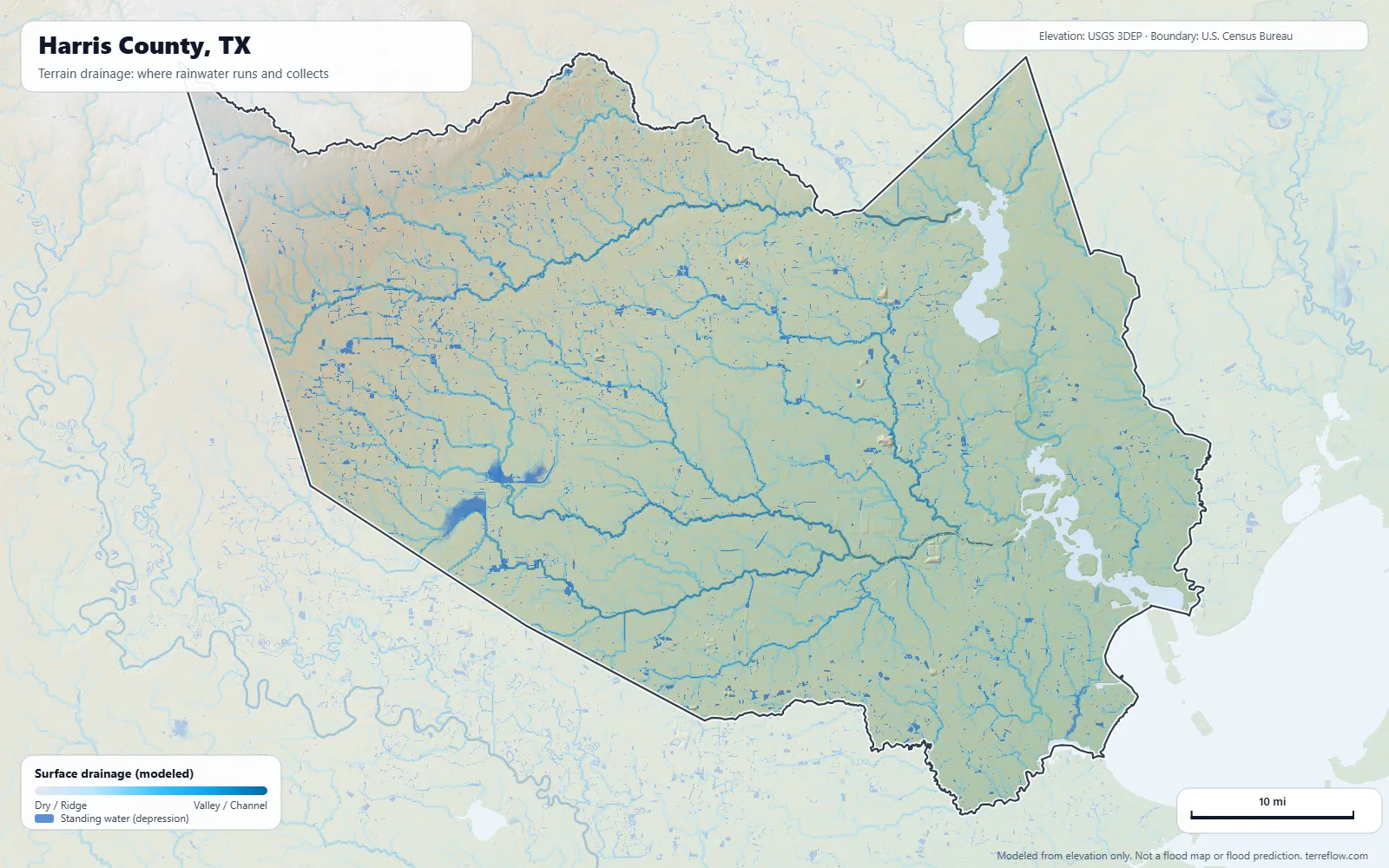
Where does rainwater drain in Harris County? This interactive map shows surface drainage patterns across Houston and surrounding areas based on terrain shape - where gravity directs rainwater based on elevation and slope. For official flood risk information, see the FEMA flood zone layer on the Hazards tab.

For a Houston or Harris County property, compare terrain-based drainage with the separate FEMA flood zone layer. Use the official Harris County mapping and rainfall resources in the guide below to check the address and its watershed. Terrain flow lines are not a record of past flooding at a house or a prediction of stormwater depth. Choose a location to see surface drainage analysis and water flow direction based on terrain shape. The first three locations are free.

Interpretation

Select a location on the map or enter an address to see terrain analysis.

3D Terrain Visualization
Where does rainwater flow based on terrain shape? Blue areas show where water collects and drains downhill.
Units
Report a problem
—
Terrain drainage map of Harris County, TX: modeled paths where rainwater runs and collects, from USGS 3DEP elevation data, with the county boundary Click any spot on the map to analyze it
4.0× Horizontal:Vertical
Elevation loading...

Harris County flood history

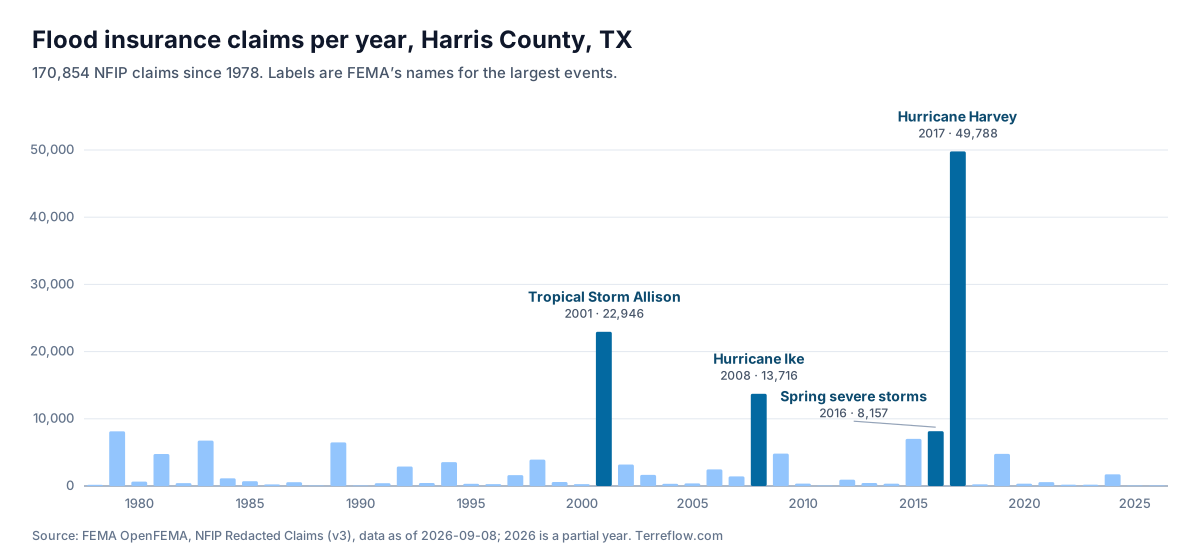
FEMA records 170,854 flood insurance claims in Harris County since 1978, with about $8.7 billion paid. 55% of the claims with a rated flood zone came from moderate- or low-risk zones (X, B or C), outside the high-risk areas on FEMA’s flood maps.

Among the 50 largest U.S. cities, Houston ranks #1 for FEMA flood insurance claims per home: 83.8 claims per 1,000 homes since 1978 (87,196 claims within city limits). See all 50 cities

Bar chart of FEMA flood insurance claims per year in Harris County, TX, 1978 to 2026, highest in 2017 (Hurricane Harvey) with 49,788 claims.

Biggest flood years

  1. 2017 · Hurricane Harvey · 49,788 claims
  2. 2001 · Tropical Storm Allison · 22,946 claims
  3. 2008 · Hurricane Ike · 13,716 claims
  4. 2016 · Spring severe storms · 8,157 claims
  5. 1979 · 8,140 claims

ZIP codes with the most claims

ZIPClaimsShare
770896,7423.9%
770966,4823.8%
775714,7972.8%
775864,7832.8%
770884,6602.7%
770374,1972.5%
770404,1572.4%
770343,5242.1%

How to read this. These are National Flood Insurance Program claims, so they count only insured buildings and miss flooding where owners had no flood insurance. FEMA publishes them without names or addresses: they show which years and areas flooded, never whether a particular house did. ZIP codes are as reported on the claims, and a ZIP code can extend beyond the county. The “rated” flood zone is the one used to price the policy and may come from an older map. Data as of 2026-09-08, from FEMA OpenFEMA.

Sunlight and soil in Harris County

Sunlight. Ground here gets about 4.9 kWh of sunlight per square meter per day on average (4.7 to 5.0 across the map), above the middle of the lower 48 (4.5). South-facing slopes get more, north-facing ones less.

Soil. The ground is mostly loamy soil over a clay-rich subsoil (Luvisols 67%), with swelling clay (Vertisols 33%). Rain soaks in, then slows at the clay layer. Swelling clay also shrinks and cracks as it dries, which can move slabs and foundations.

Sunlight: long-term average on flat ground from the National Solar Radiation Database (National Laboratory of the Rockies, formerly NREL). Soil: most likely soil types from ISRIC SoilGrids, a 250 m model, not a survey of any lot. Both cover the map area above.

Checking a Houston or Harris County property

For a Houston address, separate three checks: its mapped FEMA flood zone, the terrain around the property, and observations of rainfall or water levels. These sources do not answer the same question. A county overview cannot establish whether an individual house flooded, and a favorable terrain view is not a guarantee against flooding.

How do I find the flood zone for a Harris County address?

  1. Search the address above or choose a map point. Read Elevation and Surface Drainage together, then open Hazards → Flood for the separate FEMA flood zone layer. Check that the point matches the intended property.
  2. Look up the same address in the FEMA Map Service Center. Review the effective map and relevant map changes rather than assuming a draft or preliminary map is already effective.
  3. Harris County's Floodplain Management page directs residents to the Flood Education Mapping Tool for local flood hazard information. Its About page explains that the tool is not the effective FIRM. Verify the effective map through FEMA and ask the applicable floodplain administrator about a boundary or proposed project.

Where can I check Houston rainfall, bayous, and nearby gauges?

Use the official Harris County Flood Warning System to search the address, identify nearby gauges, and explore its watershed and channel layers. The system offers rainfall and water-level information, historical rainfall views, and site alerts. Use those observations to understand the local setting, not to assign one uniform risk to all of Harris County.

Read the selected gauge's time, location, and units before comparing observations. A nearby gauge measures conditions at that station, not water inside a particular home. Missing or stale readings are not evidence of safe conditions. For an active storm, follow official weather and local emergency warnings; Terreflow is not an emergency alert or evacuation tool.

Does a flood-zone map show whether a Houston house flooded before?

No. Terreflow does not provide verified property flood history or insurance-claim records. A mapped hazard zone and a record of damage to a particular building are different kinds of evidence. Historical rainfall at a gauge also cannot prove whether water entered that building. If past flooding matters to a purchase, request property-specific documentation and ask the local authority which relevant records may be available.

Who handles local drainage or floodplain questions?

The Flood Control District's roles and responsibilities guide distinguishes FEMA mapping, county infrastructure and localized drainage, and district flood-control projects. For unincorporated Harris County, start with the county's Floodplain Management resources; inside a city, confirm the city office responsible for the property. Do not assume the Flood Control District handles every street drain or permit question.

Terrain flow lines cannot resolve the capacity of street drains, culverts, pipes, or every local grading change. They do not simulate a storm or predict flood depth. Use the terrain view as an initial check, then verify official mapping and obtain site-specific professional advice for design or development decisions. Read Terreflow's data and limitations.

This guide is free to read. Interactive analysis shares the first three free locations across county and city pages and Analyze; the fourth distinct location requires a one-time $4.99 pass for 30 days, with no subscription or auto-renewal. Analyze a specific address.

Explore more flood and drainage maps

Browse all 64 flood and drainage maps · Flood insurance claims in the 50 largest cities · How Terreflow uses terrain and FEMA data