Sacramento (Sacramento County), CA Flood Zone & Drainage Map
Address
Overview
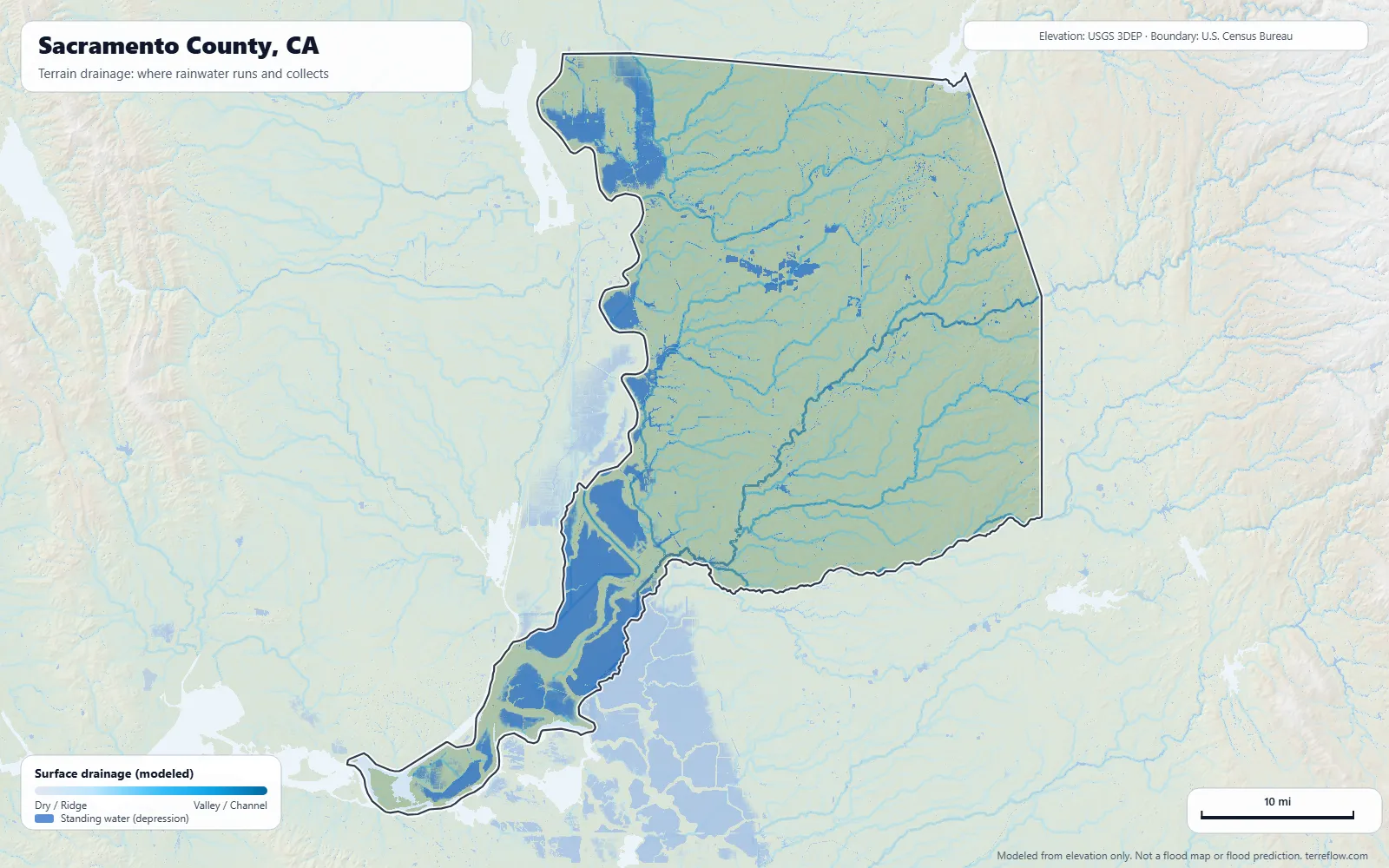
Where does rainwater drain in Sacramento County? This interactive map shows surface drainage patterns across Sacramento, Elk Grove, Rancho Cordova, and surrounding areas based on terrain shape - where gravity directs rainwater based on elevation and slope. For official flood risk information, see the FEMA flood zone layer on the Hazards tab.
Sacramento sits at the confluence of the Sacramento and American Rivers on the flat Central Valley floor, making it one of the most flood-prone cities in the United States. The Natomas basin north of downtown is protected by levees but sits below river level during high water. Clay-rich alluvial soils drain poorly, and atmospheric river storms can deliver weeks of rainfall in days. Choose a location to see surface drainage analysis and water flow direction based on terrain shape. The first three locations are free.
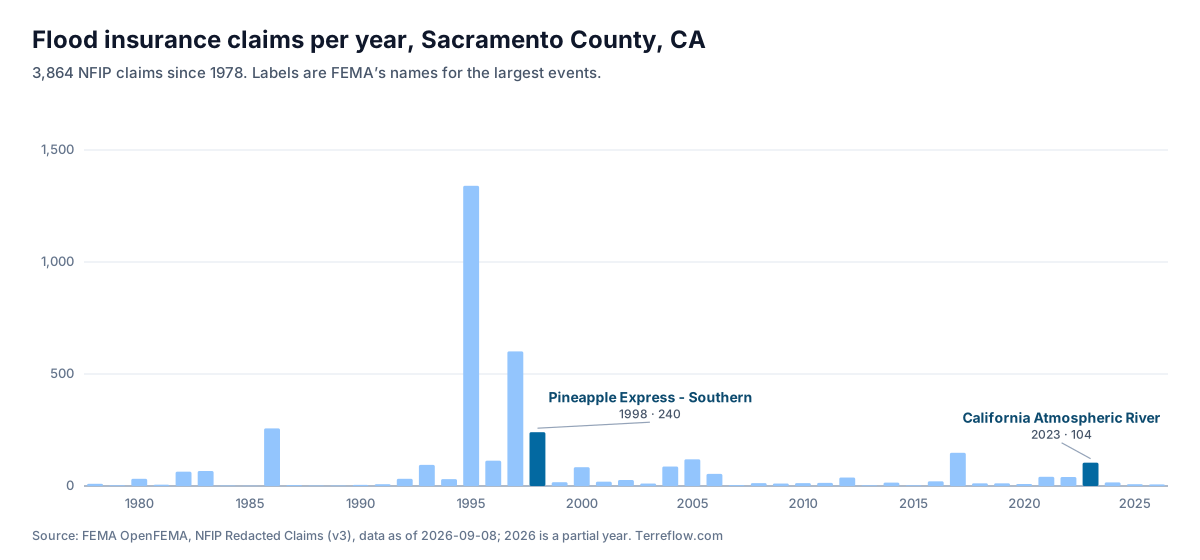
FEMA records 3,864 flood insurance claims in Sacramento County since 1978, with about $39 million paid. 24% of the claims with a rated flood zone came from moderate- or low-risk zones (X, B or C), outside the high-risk areas on FEMA’s flood maps.
Among the 50 largest U.S. cities, Sacramento ranks #10 for FEMA flood insurance claims per home: 9.2 claims per 1,000 homes since 1978 (1,960 claims within city limits). See all 50 cities
Biggest flood years
1995 · 1,340 claims
1997 · 601 claims
1986 · 257 claims
1998 · Pineapple Express - Southern · 240 claims
2017 · 148 claims
ZIP codes with the most claims
ZIP
Claims
Share
95823
306
7.9%
95822
291
7.5%
95673
277
7.2%
95833
230
6.0%
95825
190
4.9%
95838
143
3.7%
95837
135
3.5%
95610
126
3.3%
Delta islands. In the Sacramento–San Joaquin Delta, many islands sit below the level of the surrounding rivers, protected by levees and drained by pumps. On the terrain map they show as standing water, because elevation data alone can’t see that system.
How to read this. These are National Flood Insurance Program claims, so they count only insured buildings and miss flooding where owners had no flood insurance. FEMA publishes them without names or addresses: they show which years and areas flooded, never whether a particular house did. ZIP codes are as reported on the claims, and a ZIP code can extend beyond the county. The “rated” flood zone is the one used to price the policy and may come from an older map. Data as of 2026-09-08, from FEMA OpenFEMA.
Sunlight. Ground here gets about 5.2 kWh of sunlight per square meter per day on average (5.0 to 5.3 across the map), above the middle of the lower 48 (4.5). South-facing slopes get more, north-facing ones less.
Soil. The ground is mostly loamy soil over a clay-rich subsoil (Luvisols 58%), with swelling clay (Vertisols 26%). Rain soaks in, then slows at the clay layer. Swelling clay also shrinks and cracks as it dries, which can move slabs and foundations.
Sunlight: long-term average on flat ground from the National Solar Radiation Database (National Laboratory of the Rockies, formerly NREL). Soil: most likely soil types from ISRIC SoilGrids, a 250 m model, not a survey of any lot. Both cover the map area above.
Colors show height above sea level. Green = low ground, tan/brown = mid elevation, white = peaks. The color scale adapts to the area you're viewing.
Contour lines connect points of equal elevation. Closely packed lines = steep slope. Widely spaced = gentle or flat terrain.
Why it matters: Elevation tells you where water naturally drains — and where it collects.
Hydro tab
Shows where water goes when it rains. Deep blue areas are valley bottoms and stream channels. Light gray/white areas are ridges and high ground.
The moving dots simulate water particles following the terrain downhill.
Why it matters: A valley-bottom lot means all the rainwater from surrounding hills eventually passes through your land.
Solar tab
Colors show the long-term average sunlight on flat ground (GHI, kWh/m² per day, the same as peak sun hours) from the National Solar Radiation Database. Zoomed in, south-facing slopes read higher and north-facing ones lower.
US ranges: Southwest 5.5–6.5, Southeast/Midwest 4.5–5.5, Pacific NW/New England 3–4.
Hazards tab
Flood
Official FEMA flood zones. Zone AE/A: high risk (100-year flood). Zone X shaded: moderate. Zone X unshaded: minimal. Zone V/VE: coastal wave action.
Seismic
Ground shaking hazard from USGS. The Ss value is ground acceleration as a fraction of gravity.
Fault lines
Mapped fault traces from the USGS Quaternary Fault Database.
Fire
Wildfire Hazard Potential from USFS — structural risk based on fuel load and fire weather.
Soil tab
Colors show the most likely soil type from ISRIC SoilGrids; the legend lists the types in view. Select a location for its clay %, pH and organic carbon. Clay soaks up rain slowly, so more of it runs off; sand drains fast.
Controls
Address box: accepts addresses, place names, lon,lat pairs, or Mercator coordinates.
ft/m: unit toggle. Contours: on/off. Exaggeration slider: vertical stretch.
 Click any spot on the map to analyze it