New Orleans (Orleans Parish), LA Flood Zone & Drainage Map

Address
Overview

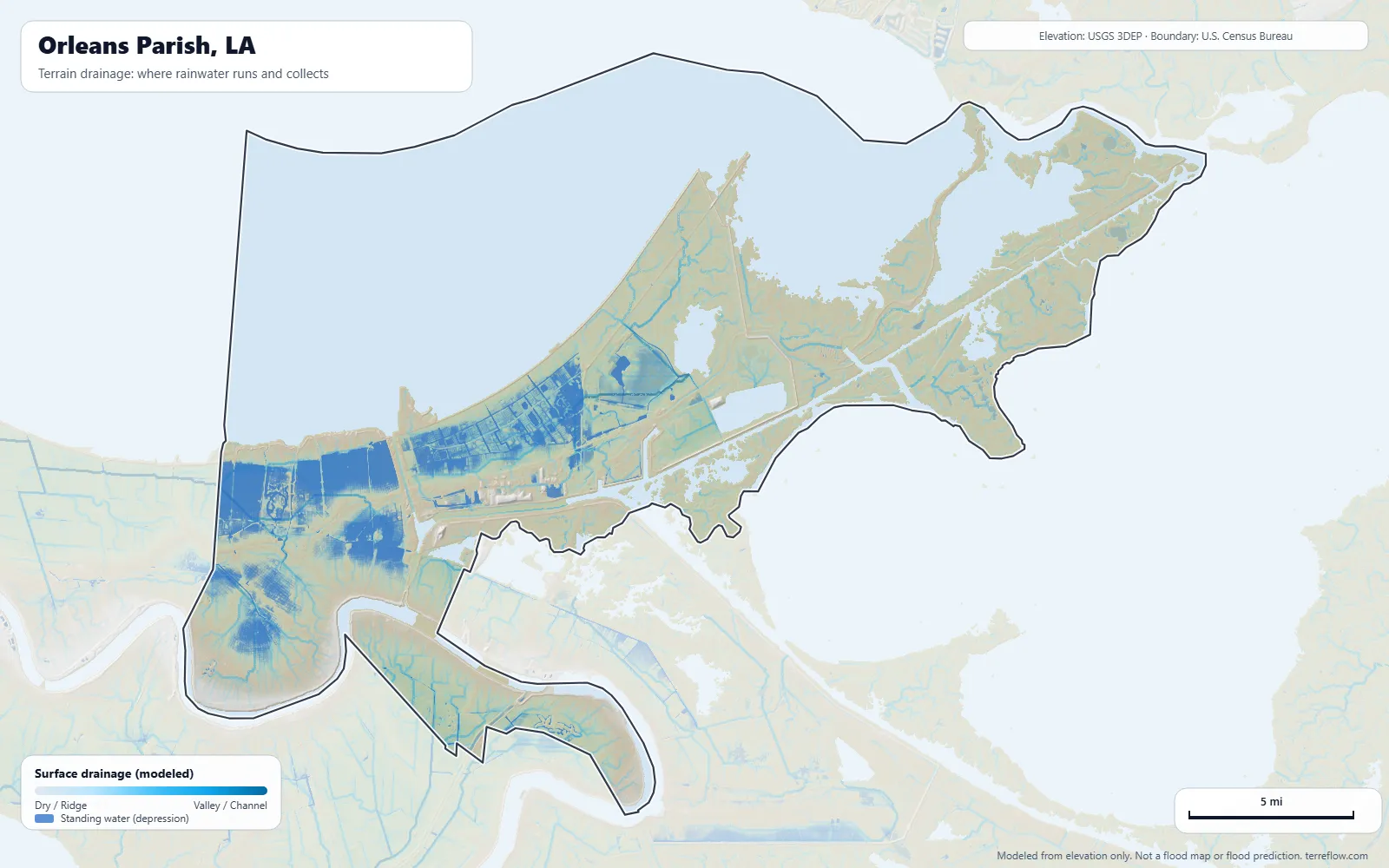
Where does rainwater drain in Orleans Parish? This interactive map shows surface drainage patterns across New Orleans and surrounding areas based on terrain shape - where gravity directs rainwater based on elevation and slope. For official flood risk information, see the FEMA flood zone layer on the Hazards tab.

Orleans Parish sits in a bowl largely below sea level, making it entirely dependent on levees and mechanical pump stations for drainage. Rainwater cannot drain by gravity - it must be pumped out through the city's 120+ drainage pump stations into Lake Pontchartrain and the Mississippi River. Heavy clay soils and subsidence compound the drainage challenge. Choose a location to see surface drainage analysis and water flow direction based on terrain shape. The first three locations are free.

Interpretation

Select a location on the map or enter an address to see terrain analysis.

3D Terrain Visualization
Where does rainwater flow based on terrain shape? Blue areas show where water collects and drains downhill.
Units
Report a problem
—
Terrain drainage map of Orleans Parish, LA: modeled paths where rainwater runs and collects, from USGS 3DEP elevation data, with the parish boundary Click any spot on the map to analyze it
4.0× Horizontal:Vertical
Elevation loading...

Orleans Parish flood history

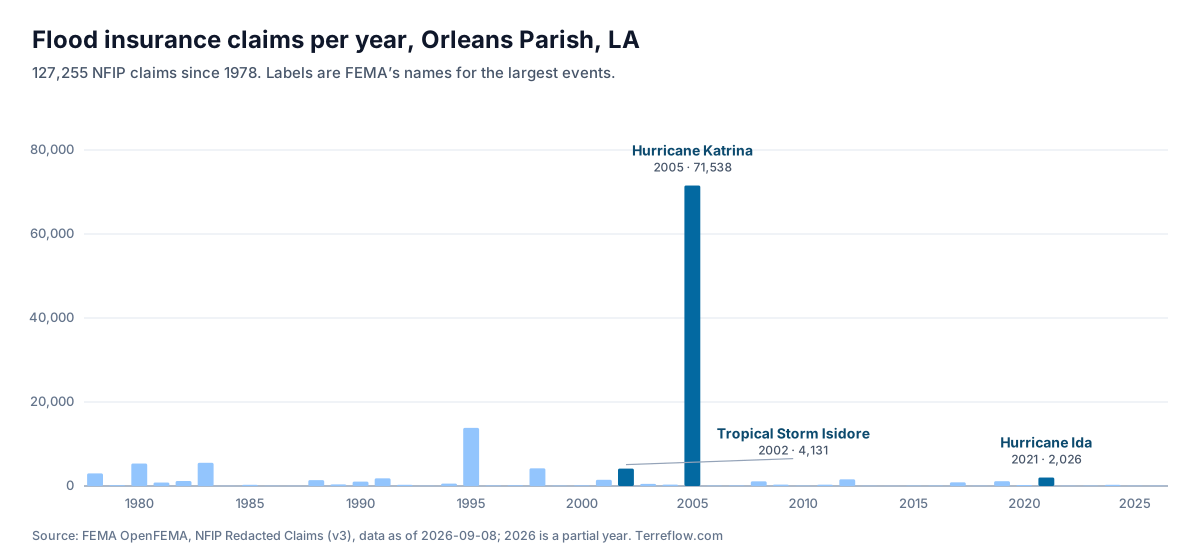
FEMA records 127,255 flood insurance claims in Orleans Parish since 1978, with about $7.2 billion paid. 25% of the claims with a rated flood zone came from moderate- or low-risk zones (X, B or C), outside the high-risk areas on FEMA’s flood maps.

Bar chart of FEMA flood insurance claims per year in Orleans Parish, LA, 1978 to 2026, highest in 2005 (Hurricane Katrina) with 71,538 claims.

Biggest flood years

  1. 2005 · Hurricane Katrina · 71,538 claims
  2. 1995 · 13,842 claims
  3. 1983 · 5,521 claims
  4. 1980 · 5,362 claims
  5. 1998 · 4,204 claims

ZIP codes with the most claims

ZIPClaimsShare
7012215,52912.2%
7012613,14710.3%
7011911,3808.9%
7012411,0758.7%
7012510,7668.5%
7011710,1468.0%
701189,9977.9%
701158,8256.9%

Below sea level. Much of New Orleans lies below sea level inside levees. On the terrain map these bowls show as standing water, because elevation data alone can’t see the pumps, canals and storm drains that remove rainwater. Drainage here depends on that system.

How to read this. These are National Flood Insurance Program claims, so they count only insured buildings and miss flooding where owners had no flood insurance. FEMA publishes them without names or addresses: they show which years and areas flooded, never whether a particular house did. ZIP codes are as reported on the claims, and a ZIP code can extend beyond the parish. The “rated” flood zone is the one used to price the policy and may come from an older map. Data as of 2026-09-08, from FEMA OpenFEMA.

Sunlight and soil in Orleans Parish

Sunlight. Ground here gets about 4.9 kWh of sunlight per square meter per day on average (4.8 to 5.0 across the map), above the middle of the lower 48 (4.5). South-facing slopes get more, north-facing ones less.

Soil. The ground is mostly swelling clay (Vertisols 51%), with loamy soil over a clay-rich subsoil (Luvisols 23%, Acrisols 22%). Rain soaks in slowly, so more of it runs off. Swelling clay also shrinks and cracks as it dries, which can move slabs and foundations.

Sunlight: long-term average on flat ground from the National Solar Radiation Database (National Laboratory of the Rockies, formerly NREL). Soil: most likely soil types from ISRIC SoilGrids, a 250 m model, not a survey of any lot. Both cover the map area above.

Explore more flood and drainage maps

Browse all 64 flood and drainage maps · Flood insurance claims in the 50 largest cities · How Terreflow uses terrain and FEMA data